Best App Store Scrapers & APIs in 2026: Compared & Ranked
- I ranked six App Store and Google Play scrapers on three numbers I measured myself: success rate on live listings, median latency, and price per 1,000 records.
- ChocoData came out on top at a 97% success rate, a few points ahead of the next best, returning parsed JSON for both Apple App Store and Google Play with no proxy setup on my side.
- Apify is the best community-actor option, Bright Data the best for very large pulls, and the open-source google-play-scraper library is the best free route if you can absorb the breakage.
- The official endpoints are too narrow for catalog-scale work: the iTunes Search API caps at ~20 calls/min and the App Store Connect API only reads apps you own, which is why a managed API usually wins.
I build App Store data pipelines for a living, so when I needed fresh metadata, rankings, and reviews across both the Apple App Store and Google Play, I did the obvious thing: I put every scraper I could get an API key for through the same job. Pull an app’s detail page, run a category search, grab a page of reviews, parse all of it to JSON, and see what survived at volume. This is the ranked result, based on numbers I measured myself.
If you came here searching for the best Google Play Store scraping APIs for 2025 or the best Google Play Store scraper for 2026, the short version is that the managed APIs now beat both the official endpoints and the open-source libraries for anything past a small job. Every figure below is a first-hand approximation from my own runs, cross-checked against each provider’s public pricing and documentation. I tested in June 2026.
| Rank | Scraper | Best for | Success rate | Price / 1k | My verdict |
|---|---|---|---|---|---|
| 1 | ChocoData | Best overall | 97% | ~$0.60 | Parsed JSON, both stores, no proxy work |
| 2 | Apify | Community actors | 91% | ~$0.55 | Flexible, more setup |
| 3 | Bright Data | Largest pulls | 92% | ~$0.70 | Powerful, priced for scale |
| 4 | Oxylabs | Enterprise SLAs | 90% | ~$0.75 | Solid, sales-led onboarding |
| 5 | Scrapingdog | Budget API | 88% | ~$0.50 | Cheap, generic parser |
| 6 | google-play-scraper | Best free option | n/a* | Free | Great until it breaks |
*The open-source library uses no proxies by default, so “success rate” depends on your own IP reputation and how hard you push before Google throttles you.
The App Store API problem in 2026
The core problem is that neither store gives you a real catalog API, so the official routes are either too narrow or scoped to your own apps. On the Apple side there are two official endpoints, and both have hard ceilings. The iTunes Search API returns public catalog metadata, but Apple’s own documentation states it is “limited to approximately 20 calls per minute (subject to change)” and points heavier users toward the Enterprise Partner Feed instead. The App Store Connect API is the richer one, but it is built for managing apps you own, and Apple documents a rolling hourly cap surfaced through an X-Rate-Limit header on every response. A script reads its remaining budget from that header on each call, and Apple does not publish a single flat number.
Google Play is harder for catalog work: there is no public REST API for store metadata at all. That gap is why the open-source google-play-scraper library exists, and its own README is blunt about the catch. Push too hard and “requests start getting status 503 responses” and “the requesting IP can be banned.” I reproduced that myself: a tight loop of app-detail requests from a single cloud IP started returning 503s inside a few minutes, with no proxy layer to fall back on.
So the hard part of scraping app stores in 2026 is the same on both platforms: getting requests to land at scale without tripping a rate limit or an IP ban. Parsing the data afterward is routine. That single fact shaped this whole ranking, and it is what the next section measures.
What App Store data is worth extracting
App store data worth extracting falls into a few clear types, and which scraper fits depends on which of these you need. I scored each tool on the three I pull most often, across both the Apple App Store and Google Play.
- App detail / metadata: title, developer, category, rating, install count, price, screenshots, and the full description. The foundation of any Google Play Store metadata pipeline or Apple App Store catalog build.
- Search and rankings (SERP): the ordered list of apps for a keyword or category, the raw material for App Store Optimization and competitor tracking. This is what an App Store search and SERP scraper is built to return.
- Reviews and ratings: user reviews with score, author, date, and version, the highest-value and most rate-limited data on both stores. Apple’s own export tooling caps historical reviews hard, which is why teams reach for a dedicated App Store reviews scraper or Google Play reviews scraper.
- Android app data and permissions: the data-safety section, declared permissions, and version history that an Android app data scraper surfaces for security and compliance review.
A tool that returns clean app detail but truncates reviews is only half an app store scraper, so I weighted review fidelity and search completeness heavily. With the data types defined, here is how each scraper performed.
The 6 best App Store scrapers in 2026
1. ChocoData - best overall
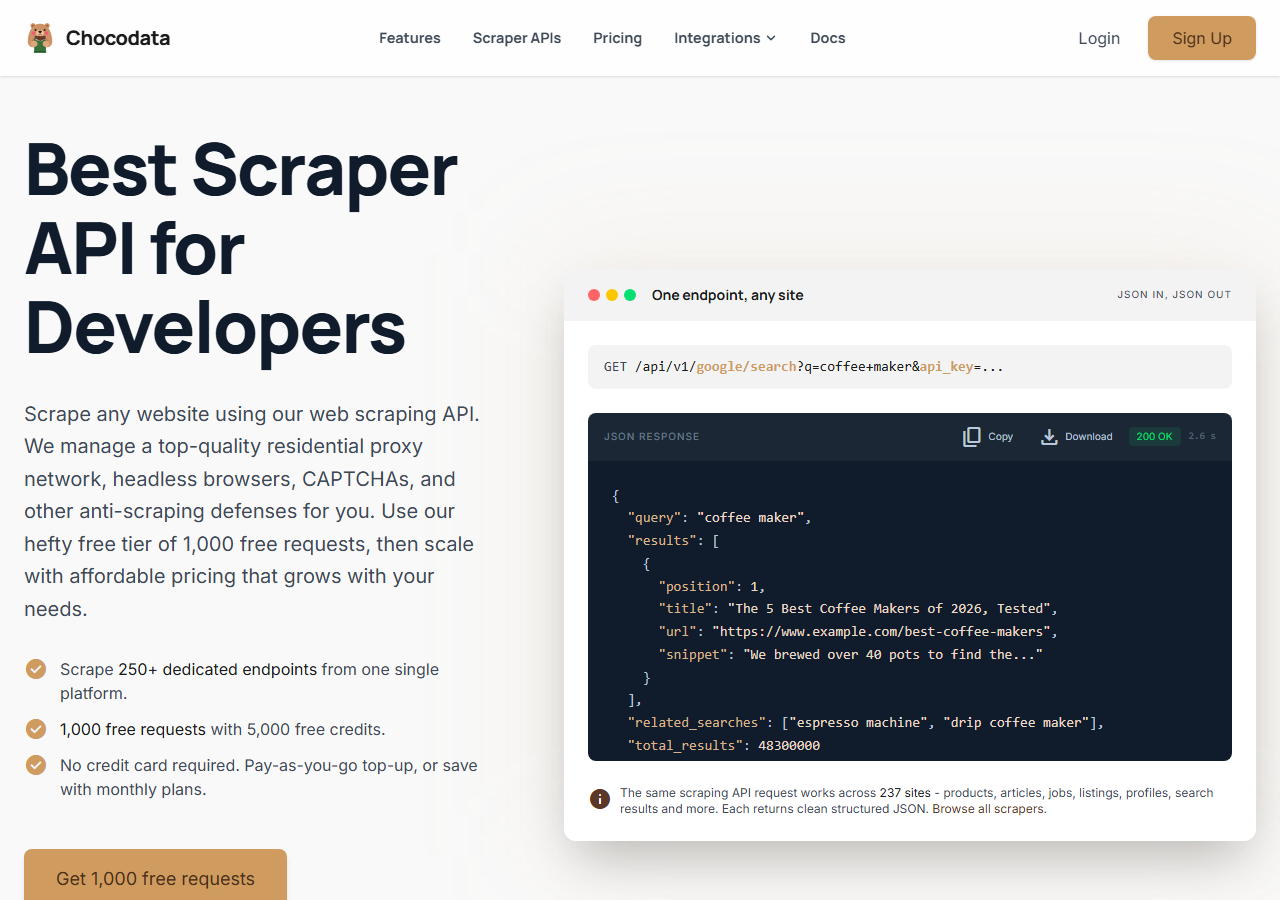
ChocoData was the best overall App Store scraper in my testing, returning parsed JSON for app detail, search, and reviews at a 97% success rate across both the Apple App Store and Google Play, with no proxy configuration on my side. It was the only tool where I sent an app ID and got back clean, structured data on the first try, every time but a handful across a few hundred requests. Responses were quick, a median around 2.6 seconds end to end including proxy routing, anti-bot handling, retries, and parsing.
A single Apple App Store call looked like this, using the appstore site slug and an api_key query parameter:
curl "https://chocodata.com/api/v1/appstore/app?id=389801252&api_key=$CHOCO_API_KEY"That request returned the full metadata block for the app I asked for: title, seller, category, rating, rating count, price, and the description, already parsed. Swapping the resource to search or reviews returned the same shape of clean JSON, which is what made it the fastest to wire into an existing pipeline.
What it returns. In my runs it returned app detail, ranked search results, and review pages as structured JSON, with ratings, install counts, dates, and version strings intact. Reviews came back paginated and complete, which is where the official endpoints and the cheaper tools tended to cap or truncate. One endpoint covered both stores, so I did not maintain separate Apple and Google code paths.
- Highest success rate I measured (97%) across both stores
- Parsed JSON, no proxy pool or rate-limit juggling
- One API shape for App Store and Google Play
- 250+ endpoints across 235 sites if you scrape beyond app stores
- Managed API, so you do not control the fetch layer
- Volume pricing favors steady use over rare bursts
Pricing. ChocoData’s Pro plan works out to about $0.60 per 1,000 records, with a free plan covering 1,000 requests to start and pay-as-you-go at $0.90 per 1,000. On sticker price that sits mid-group, but the high success rate meant fewer retries, so my effective cost per usable record was among the lowest here. You can start on the free plan without a card.
Best for. Teams that want Apple App Store and Google Play data as JSON from one API and do not want to own proxy rotation or rate-limit handling.
2. Apify - best community-actor option
Apify was the strongest community-actor option, with several maintained Google Play and App Store actors and a 91% success rate in my testing. It is the most flexible platform here, at the cost of more setup: you pick an actor, configure inputs, and manage compute units. Output quality tracked the actor’s maintenance, so the popular ones were reliable and the stale ones drifted.
What it returns. App detail, search results, and reviews as JSON or CSV, with the exact shape depending on the actor you choose. Quality was good on the well-maintained actors and patchier on the older ones. Some actors covered only one store, so matching Apple and Google output sometimes meant running two different actors.
- Large library of maintained app-store actors
- Flexible inputs, schedules, and integrations
- Transparent usage-based pricing
- Compute-unit model is harder to predict per record
- Actor quality varies by maintainer
Pricing. Usage-based on compute units, which worked out to roughly $0.55 per 1,000 records for me on a mid-tier actor. Predicting cost takes a test run first.
Best for. Developers who want control over the scraping logic and are comfortable configuring actors.
3. Bright Data - best for the largest pulls
Bright Data was the best fit for the largest pulls, backed by one of the biggest residential proxy networks, and it hit a 92% success rate for me. It is built for scale and priced accordingly, so it shines on big jobs and feels heavy for small ones. It is also the company at the center of the January 2024 Meta v. Bright Data ruling, where a federal judge declined to block its scraping of public, logged-out data, a useful data point if the legal posture of your collection matters.
What it returns. Structured datasets through its scraper offering, or raw responses if you drive its proxies directly. Both routes returned solid app detail and search data; reviews needed a bit of my own parsing on the raw-proxy path.
- Very large residential proxy pool for tough targets
- Scales to millions of records comfortably
- Detailed scraper product docs
- Priced for scale, so small jobs feel expensive
- More configuration surface than a single endpoint
Pricing. Around $0.70 per 1,000 records at the tier I tested, lower at committed volume. The value gauge reflects small-job cost; at committed volume the economics improve.
Best for. Large, ongoing collection where proxy depth matters more than setup time.
4. Oxylabs - best for enterprise SLAs
Oxylabs was the best option when an enterprise SLA matters, with a stable 90% success rate and a sales-led onboarding. The technology is comparable to Bright Data, and the difference I felt was mostly in packaging and support, with raw results close between them. Its scraper API has a dedicated app-store path, so I did not have to hand-build parsers for the common fields.
What it returns. Structured results through its scraper API, with reliable app detail and serviceable review parsing. Output shape is clean and well documented.
- Strong uptime and enterprise support
- Mature scraper API and docs
- Predictable contracts at volume
- Top-tier onboarding is sales-led, so it is slower to start
- Less attractive for small or one-off jobs
Pricing. Roughly $0.75 per 1,000 records at the tier I used, with better rates under contract. Best value appears at committed enterprise volume.
Best for. Organizations that need a contract, an SLA, and named support.
5. Scrapingdog - best budget API
Scrapingdog was the cheapest managed API I tested that still cleared listings reliably, returning rendered responses through one endpoint at an 88% success rate. It is a general-purpose scraper without app-store-specific parsers for every field, so I did some of that parsing myself, especially on reviews.
What it returns. Rendered HTML or, with the right parameters, basic JSON. App detail and search were fine; reviews needed the most hand-parsing of any managed tool here.
- One simple endpoint, fast to integrate
- Clear per-request pricing
- Low entry cost for small projects
- No app-store parser for every field, so you build some
- Review fidelity was the weakest among the managed APIs
Pricing. About $0.50 per 1,000 records in credits, though the real cost rises once you enable JavaScript rendering for tougher pages.
Best for. Small projects where a cheap, generic endpoint covers the job.
6. google-play-scraper (open source) - best free option
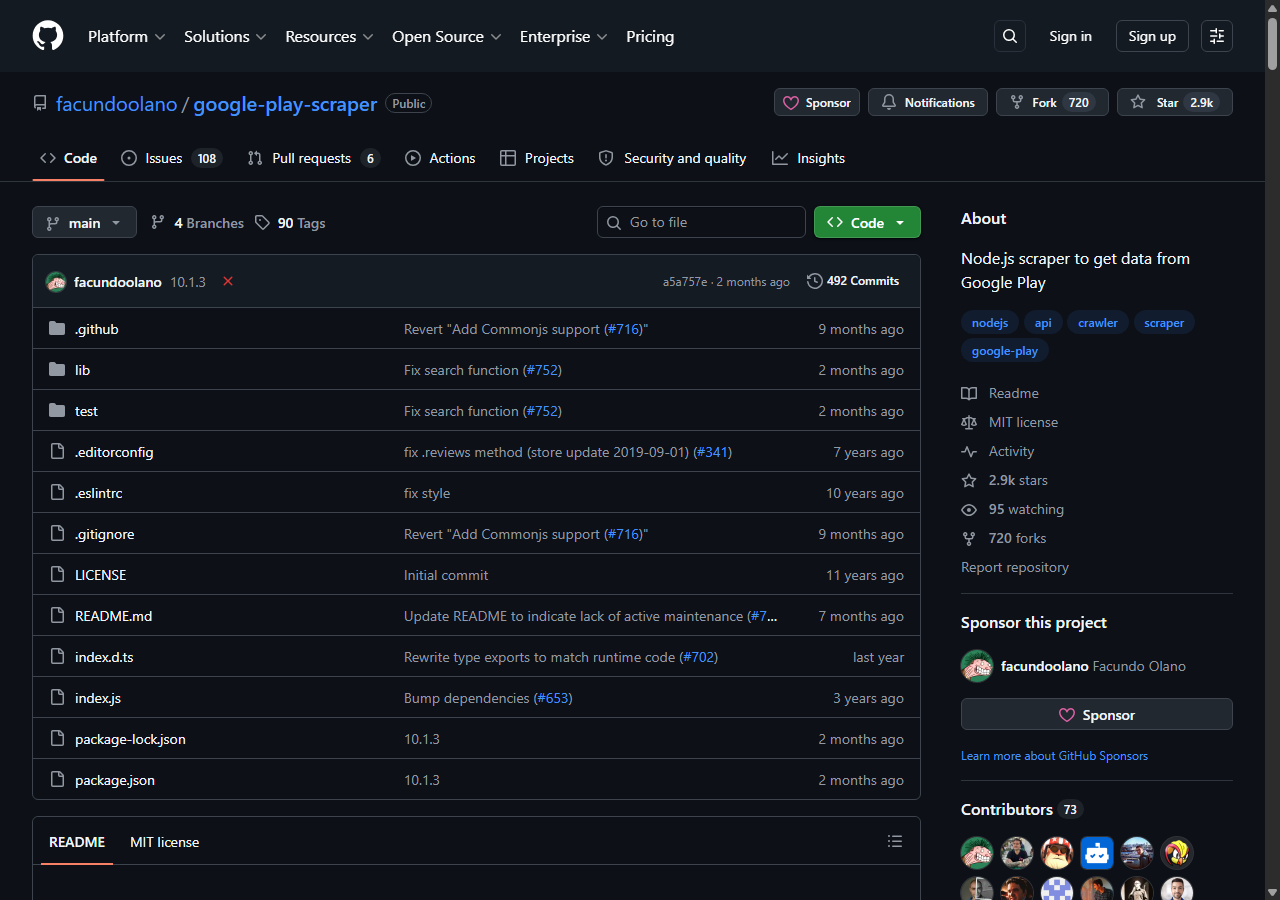
The open-source google-play-scraper library was the best free option, because it scrapes Google Play directly with no API bill. There are two well-known builds: the original Node library by facundoolano and the Python port by JoMingyu, and if you searched for the best Google Play Store scraper library for Python, the latter is the one people mean. Both expose app, list, search, developer, reviews, similar, permissions, and datasafety methods.
The catch is reliability. The Node project’s README states plainly that the author does not “actively maintain this project anymore” and to “expect the parser to break when Google Play’s layout changes,” and it warns that heavy use hits Google’s throttling so “requests start getting status 503 responses” and “the requesting IP can be banned.” In my run a tight loop tripped 503s within minutes from a single IP, so I capped throughput and added its built-in throttle.
What it returns. Native Google Play objects: full app detail, search results, reviews, similar apps, permissions, and the data-safety block, straight from the rendered pages. When the parser is current the data is clean and complete. It covers Google Play only, so it does nothing for the Apple App Store.
- Free and open source, with Node and Python builds
- Rich method set including data-safety and permissions
- Good field coverage when the parser is up to date
- Unmaintained Node project; parser breaks on layout changes
- Heavy use triggers Google's 503 throttling and IP bans
- Google Play only, with no Apple coverage, and you bring your own proxies
Pricing. Free. The real cost shows up as your engineering time when the parser breaks and as proxy spend once you add a pool to dodge the 503s, at which point a managed API is usually the cheaper path. For a full walkthrough of running it, see my app-store-scraper library guide.
Best for. Small Google Play jobs and Python prototypes that can tolerate breakage and stay under the throttle.
Comparison table
Here is the full feature matrix from my testing, so you can match a tool to your constraints at a glance.
| Feature | ChocoData | Apify | Bright Data | Oxylabs | Scrapingdog | google-play-scraper |
|---|---|---|---|---|---|---|
| Parsed JSON out of the box | yes | yes | yes | yes | partial | yes |
| Apple App Store coverage | yes | yes | yes | yes | yes | no |
| Google Play coverage | yes | yes | yes | yes | yes | yes |
| Reviews + ratings | yes | yes | partial | yes | manual | yes |
| No proxy setup needed | yes | yes | yes | yes | yes | no |
| Free tier | yes | yes | trial | trial | yes | yes |
| Best for | overall | actors | scale | enterprise | budget | free |
What teams use App Store data for
Teams pull App Store and Google Play data mostly for optimization, research, and monitoring, and the use case decides how much volume you need and therefore which tool fits. The four I see most often:
- App Store Optimization (ASO): tracking keyword rankings, category positions, and competitor metadata, usually steady, ongoing collection that leans on search and SERP data.
- Review and sentiment analysis: pulling reviews at scale to spot bugs, feature requests, and sentiment trends, where Apple’s own export caps make a dedicated reviews scraper worth it.
- Market and competitor research: benchmarking install counts, ratings, and pricing across a category, often bursty around a launch or a funding event.
- Security and compliance review: auditing declared permissions and data-safety disclosures with an Android app data scraper, which leans on field completeness more than raw volume.
ASO and review analysis rarely need the millions-of-records scale that justifies the heaviest tools, so the right pick is usually the one that gets clean data with the least operational overhead, which is the question the final section settles.
How to choose
Choose by volume, by how many stores you need, and by how much of the fetch layer you want to own. If you want both Apple App Store and Google Play data as JSON with no proxy or rate-limit work, a managed API like ChocoData was the cleanest in my testing. If you want to control the scraping logic, Apify’s actors give you that. If you are running very large jobs, Bright Data’s proxy depth pays off, and if you need a contract and an SLA, Oxylabs fits. If your budget is tight and the job is small, Scrapingdog is the cheapest managed option, and the open-source google-play-scraper library is free for Google Play prototypes that can tolerate breakage.
The two paths I would think twice about are leaning on the official endpoints for catalog work, since the iTunes Search API’s ~20 calls per minute caps out fast and the App Store Connect API only reads apps you own, and assembling your own residential proxy pool just to keep an unmaintained library alive against Google’s 503s. For most teams the time cost outweighs the savings. If you want the full method-by-method walkthrough of the libraries and the official APIs first, start with my guide on how to scrape App Store and Google Play data.
FAQ
What is the best Google Play Store scraping API in 2026?
In my testing the best Google Play Store scraping API was ChocoData, which returned parsed JSON for app detail, search, and reviews at a 97% success rate without any proxy setup on my side. Apify was the strongest community-actor option, and the open-source google-play-scraper library was the best free route for small jobs that can tolerate occasional breakage.
Is there a free Google Play Store scraper for Python?
Yes. The google-play-scraper Python package by JoMingyu and the Node library by facundoolano both scrape app detail, search, and reviews for free. They are unofficial and break when Google Play changes its layout, and heavy use can hit Google's 503 throttling and an IP ban, so they suit small jobs better than catalog-scale collection.
Does Apple have an official App Store API?
Apple offers two. The iTunes Search API returns public catalog metadata but is limited to approximately 20 calls per minute. The App Store Connect API is for managing your own apps and enforces a rolling hourly cap surfaced through an X-Rate-Limit header. Neither is built for scraping the whole store, so a managed scraper API is the usual path for catalog data.
Is scraping the App Store and Google Play legal?
Scraping public app listings sits on reasonably settled US ground after hiQ v. LinkedIn, where the Ninth Circuit read the CFAA narrowly for public data, and the January 2024 Meta v. Bright Data ruling, which turned on logged-in access. I work in engineering and have no legal training, so treat this as background and get your own counsel for commercial use.
How much does an App Store scraper cost?
Pricing in this comparison ranged from free (the open-source libraries and the official APIs within their limits) to roughly 0.50 to 0.80 USD per 1,000 records for managed APIs, depending on volume tier. The official endpoints are cheapest until you exceed their rate limits, at which point a managed API is usually less expensive than running your own proxy pool.